


[Fig. 6] Survey results of Facebook users from Pew Research Center (Rainie et al.). Reproduced by the author.
On this “road less traveled,” I consolidated strong core values of independent thinking, creativity, status-quo-breaking, passion, and to some extent, rebelliousness or stubbornness. The tragedy in friends’ relationships in middle school inevitably induced me to value, a bit hysterically, authenticity and commitment from both parties.
However, the powerful guiding forces of strong values may cause me to judge things unintentionally in a specific way by inducing cognitive biases. Confirmation bias made my middle school experience darker than it was. As neuropsychiatrist Dilip V. Jeste points out in the excerpt of Wiser, we have the “tendency to search for and favor information that confirms what we already believe” (148). The subjective belief that my middle school experience was terrible pushes me to search for the related memories and evidence that only renders it worse. Additionally, sometimes I admire the winners without reminding myself their stories may just be their PR image. For example, leaders like Steve Jobs think very differently. But focusing solely on their “differences,” I may under-appreciate their ability to understand and quickly act upon the current reality. While we walk our own road, a bit of objectivity is vital to keep us off the wrong paths.
THE ROAD LESS TRAVELED BY
Two roads diverged in a wood, and I —
I took the one less traveled by,
And that has made all the difference
(Frost, Mountain Interval, 9)
While I was about to enter a “deep valley,” I came across what seemed to be the only wisp of sunlight in the dark — Apple’s 1997 advertisement “Think Different” (TBWA\Chiat\Day. This is the closest version as the original version was taken down due to copyright issues). The words of the award-winning director Lee Clow echoed in my mind, “people who are crazy enough to think they can change the world, are the ones who do” (TBWA\Chiat\Day). The massive success of Apple’s products under this value convinced me that there can be an alternate way, that all the “crazy ideas” I possess are nothing to be ashamed of but what makes me stand out, and that all conventions were coined by people that may not be smarter than me, so I can also leave my own footprints in the world. I began to embrace my “differences” and challenge myself to think before doing anything, “is there a better way?” I chose to leave the “common road” by attending an International Baccalaureate high school — the alternative path — in another city. I could embrace sunshine again.

[Fig. 5] Think Different posters (Siltanen)

FINAL DRAFT
Two Diverged Roads in the Wood
Oct 1, 2022. By Sierra Zhang.
INTRODUCTION
I believe the differences in our DNAs make us unique — not genetics, but what I call the “identity DNA.” If I introduce myself in one sentence, I will say “I’m Sierra, someone who is passionate about emerging tech, awesome ideas, daydreaming, witty stuff, and talking about or doing things I care about and finding the meanings in doing so.” The information-richness of this sentence is often underrated: everybody will choose to construct this sentence differently since our in-born natural tendencies, stimulated by education, external environment, and personal experiences, shape our passions and values, which in return form some of our cognitive biases. This ongoing process constantly adds to our “double helixes.” This essay looks into my self-identity by retracing the formulation of my DNA. While our DNAs guide us onto our unique road, algorithms increasingly try to understand us by proposing their version of our road.
A BUMPY ROAD
Growing up in China and watching other parents putting their faith in strict rules, detailed orders, and passed-on hobbies, I feel grateful that my parents believe family education is about trust, goodwill, and inspiration. ...

[Fig. 1] Asian parents stereotype meme which is real in many cases (Chinoy TV).
... They encouraged me to see the bright side of things other parents treat as toxic, like the Internet and games, and use them to explore. I discovered many refreshing ideas I would later become obsessed with on the web. For instance, digital products and designs. My elementary school drawing teacher thought I was insane when I constantly handed in drawings of imaginary digital devices while other students were obsessed with flowers and rainbows. I was unaware by then, but the early inspiration from my parents will later serve as the basis for the most important choice of my life.

[Fig. 2] Old drawings of the author.
Unfortunately, doing things differently is not promoted everywhere. The standard education system in most Chinese schools strongly values standardized approaches, order, textbooks, and score ranking. This creates hyper-competitiveness and everyday antagonism: people learn things only to be the flashy, undefeatable straight-A student. “Unfortunately,” I have always been an “outlier” in that system. I still remember how I had to lose part of myself to pass the exam for the best middle school in my city. Even when I eventually did, that “glory” did not age well — what lay ahead was the darkest three years in my life:

[Fig. 4] The grades ranking sheets were heavily annotated by teachers to indicate who has worse performance. Retrieved from the author’s photo archive (Zhang).

[Fig. 3] The homework practice exams for one weekend was thicker than an iPad. Retrieved from the author’s photo archive (Zhang).
Not only was I facing heavy course loads and strict grade rankings, but few teachers there saw my potential. Instead, they teased me in public about how abnormal I was. When I served as the design representative, many students scribbled “lame” on a poster I created since my design style was against their “standard.” Many “friends” ditched me when they thought I was “hopeless” as I constantly failed to make a comeback in grades during the final year. As I was older and more emotionally aware, I noticed how I was not fitting and started to lose confidence when nearly everyone turned away from me. My self-esteem dropped dramatically throughout middle school, and continuing down this path seemed like forever-lasting frustration.
THE OTHER ROAD: IT IS PHENOTYPICAL
While we look retrospectively at the development of our DNAs to understand who we are, advertisers walk their own path. To fully exploit the power of e-commerce, marketers use algorithms to identify conspicuous characteristics of users and build a road based on their “phenotypes.” As Open Technology Institute policy analyst Spandana Singh listed in her report “Special Delivery,” an ad provider may simplify users into inputs and focus on their demographics, behaviors, and interests to split them into targeted segments (Singh). For example, on Google’s ad personalizations page, I am a single, full-time college student, “18-24" years old, male, and speak English. They believe I am interested in technology, education, the outdoors, animals, automobiles and so on, and I will pursue computer engineering as my future career (Google). On the other hand, Facebook bet I am more interested in finding a business-related job (Meta). Marketers utilize these “phenotypic roads" to target me with their ads. Keith Kirkpatrick, the principal of 4K Research & Consulting, explains in the article “Advertising via Algorithm,” marketers can use “real-time bidding” and “programmatic advertising” to make sure I will notice the ads I want to see at the moment I want them (Kirkpatrick). The result is ads about traveling apps and solar panels always try to catch my attention on social media since algorithms believe that I am interested in traveling and a green lifestyle.
The “road” marketers create using algorithms only looks clever. Pew Research Center director of research Lee Rainie and others highlighted in the report “Facebook Algorithms and Personal Data” that over half of the surveyed Facebook users think algorithms determine their interests accurately (Rainie et al.). ...
Nevertheless, the algorithms have yet to find a way to characterize any subjective thoughts of people — their understandings are only superficial. Observing our characteristics on a phenotypical level to predict our genotypes just like the algorithms try to do is like blind people “seeing” the elephant and describing what it is — they all have educated guesses based on what they capture but forget to see the whole picture. ...

[Fig. 7] Blind people "seeing" the elephant (Himmelfarb et al.).
Just like I am obsessed with digital products because they help me create wonderful designs and projects when I walk my path. But that does not mean I will become a computer engineer as Google predicted. There are deeper reasons under human behaviors that cold machines would not understand. As Director Rainie commented in another Pew Research article that “humanity can be lost” under algorithms’ typecasting workflow as they never treat humans as “real, thinking, feeling, changing beings” (Rainie and Anderson). Algorithms successfully put me in one spot on their extrapolated “road” based on my behaviors, but that road will never be the same as the road that truly defines who I am.
FINAL THOUGHT: CONTINUING DOWN THE ROAD
Looking back on my unique road, humans are complex creatures whose “identity DNA” are shaped by systems of events and factors and, in return, shape our choice. Looking sideways, algorithms have been keeping a close eye on me to construct a laughably superficial mod of my road. Continuing down the road, the tension between the road could influence our information reception. For example, I wish to research the stories behind sensations like Think Different, or more recently, the “Will it Blend?” Series, especially in the context of the Internet. How much of it was generated by algorithms and the way they push content to users? And how much of the fame is bottled by the charisma of content creators and their DNA?
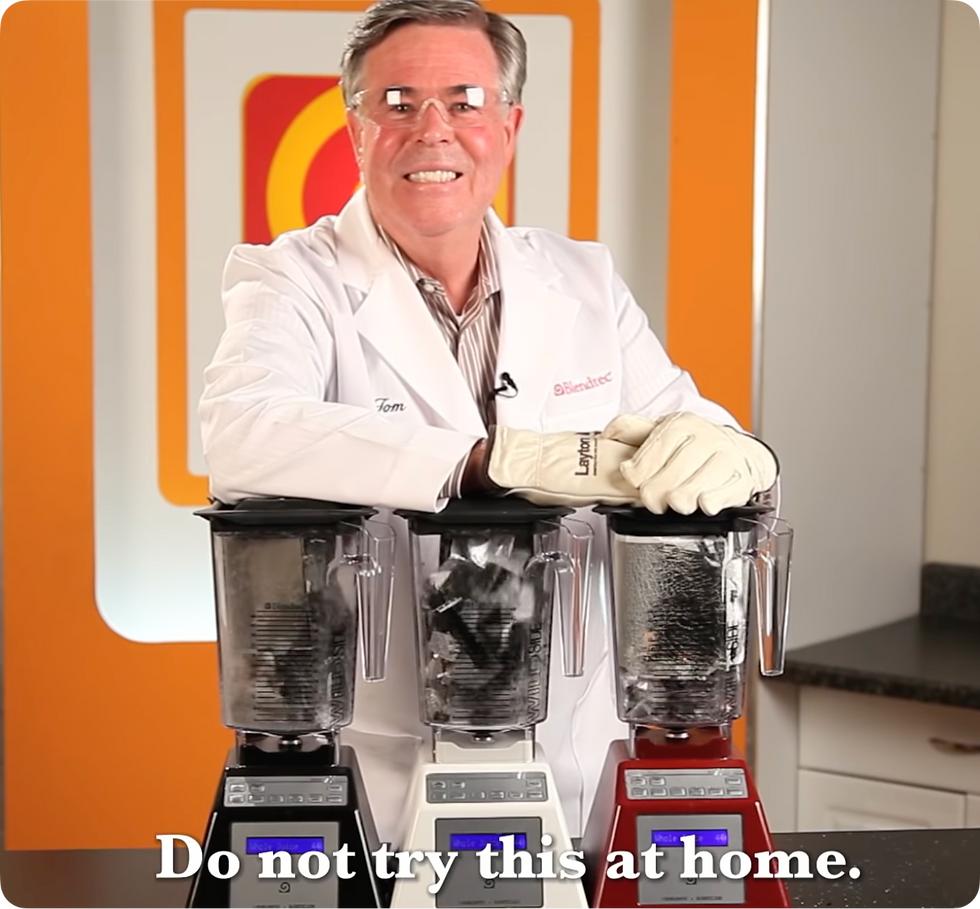
[Fig. 8] Blendtec’s CEO Tom Dickson blending tech gadgets in a “Will It Blend?” video (Blendtec’s Will It Blend?).
WORKS CITED
-
Blendtec’s Will It Blend? “Will It Blend? iPad Mini vs Kindle Fire HD vs Nexus 7.” YouTube, 6 Nov. 2012, https://www.youtube.com/watch?v=5MMmLQlrBws.
-
Chinoy TV. 8 “Things Chinese Parents Hear ALL the Time.” 17 Oct. 2020, https://www.chinoy.tv/8-things-chinese-parents-are-tired-of-hearing/.
-
Frost, Robert. Mountain Interval. New York: Henry Holt And Company, 1931.
-
Himmelfarb et al. “Perspectives in renal medicine: the elephant in uremia: oxidant stress as a unifying concept of cardiovascular disease in uremia.” Kidney Int. doi: 10.1046/j.1523-1755.2002.00600.x
-
Jeste, Dilip V. Wiser.
-
Kirkpatrick, Keith. “Advertising via Algorithm.” Communications of the ACM, 18 Feb. 2016, https://cacm.acm.org/news/198460-advertising-via-algorithm/fulltext.
-
Meta. Ad Topics. 21 Sept. 2022, https://www.facebook.com/adpreferences/ad_topics.
-
Rainie, Lee, and Janna Anderson. “Code-Dependent: Pros and Cons of the Algorithm Age.” Pew Research Center, 8 Feb. 2017, https://www.pewresearch.org/internet/2017/02/08/code-dependent-pros-and-cons-of-the-algorithm-age/.
-
Rainie, Lee, et al. “Facebook Algorithms and Personal Data.” Pew Research Center, 16 Jan. 2019, https://www.pewresearch.org/internet/2019/01/16/facebook-algorithms-and-personal-data/.
-
Siltanen, Rob. “The Real Story Of Apple’s ‘Think Different’ Campaign.” Branding Strategy Insider, 6 Feb. 2013, https://www.brandingstrategyinsider.com/the-real-story-of-apples-think-different-campaign/.
-
Singh, Spandana. “Special Delivery: How Internet Platforms Use Artificial Intelligence to Target and Deliver Ads.” New America, 18 Feb. 2020, https://www.newamerica.org/oti/reports/special-delivery/.
-
TBWA\Chiat\Day and Steve Jobs. Think Different. TBWA\Chiat\Day, https://www.youtube.com/watch?v=YBJAvi3A0H8. Accessed 20 Sep. 2022.
-
Google. “Ad personalization.” Google Ad Settings, 20 Sept. 2022, https://adssettings.google.com/authenticated?hl=en&ref=my-account.
-
Zhang, Sierra. Personal Photos.