

Final draft
What are the secrets behind online viral advertisements? An analysis based on the self-designed “Möbius strip of virality” framework
Dec 12, 2022. By Sierra Zhang.

Video-based social media sites have grown substantially over the years. TikTok, for example, will reach around 94.1 million active users in the U.S. by the end of 2022, according to Statista’s projections. On these platforms, viral videos have become the second most viewed video type worldwide in 2022. Corporate marketers have seized the potential of viral ads early by releasing many of them even long before the birth of YouTube, the world’s largest video-sharing website. But today, as the development of social media platforms enables more and more people to unleash their creativity, the concept of “ads” is not limited to corporations anymore. Viral video ads have become a popular way for every individual to promote great causes and shape their online identity — we become our own media and are represented in our viral ads. However, the growth of video-based media sites and the “everyone can create” scheme that brings also led to some threats. The design of today’s Internet is rooted in “neoliberalism,” the support of “free speech and free press” in the context of free-market capitalism, according to how Whitney Phillips, the assistant Professor in the Department of Communication at Syracuse University, illustrated in the book You Are Here (Phillips and Milner, ch. 2; Oxford English Dictionary). The focus on ultimate freedom allows more voices but cannot ensure their credibility. It, in return, led to the absence of democracy, fairness, and equity on the web by enabling viral ads designed with propaganda, disinformation (false information), and malinformation (biased information) to spread (Phillips and Milner). If they gain much attention, they will be forwarded even more, as explained by the Robert Gray Dodge Professor of Network Science at Northeastern University Albert-Laszlo Barabasi in the book Linked; and Reader in Digital Cultures and Communication at the University of East London, Tony D. Sampson’s paper “The Accidental Topology of Digital Culture: How the Network Becomes Viral”(Barabasi, ch. 7; Sampson).

INTRODUCTION
Today, citizens and self-actualizing people should educate themselves about the internal processes of internet virality. It helps with everybody’s identity empowerment by teaching us to make viral ads and promote great causes. Knowing the usual techniques ad hosts use also retrospectively help us spot whether advertisers may use them to spread propaganda online. Typically, ads get viral when the ad circulates through the actions of “seeing” and “sharing” repeatedly, just like sliding on a Möbius strip, propagating like viruses. To achieve virality, ads’ features need to be ‘infectious’ enough to persuade viewers to share, enabling them to spread and be seen by more people who would potentially share the ads.
THE MÖBIUS STRIP OF VIRALITY
To contribute to the advocacy of internet literacy, this UC Berkeley researcher offers an original design of the “Möbius strip of virality” inspired by the repeated nature of the ad propagation process. It was synthesized from the research report “Drama Goes Viral: Effects of Story Development on Shares and Views of Online Advertising Videos” written by Keith A. Quesenberry, a marketing professor and researcher at Messiah College, and Michael K. Coolsen, a professor of marketing at Shippensburg University; Albert-Laszlo Barabasi’s book Linked; and the book Viral Marketing and Social Networks by Assistant Professor at College of Business of Embry-Riddle Aeronautical University, Maria Petrescu. The Möbius strip of virality describes two major and recurring steps to help an ad go viral: seeing by a person and sharing it so more people can see it.

[Fig. 3] The Möbius strip of virality synthesized and designed by the researcher.
Viral ads show many similarities with real-life viruses shown in the diagram on the side. They “propagate” virus-like, spreading quickly to achieve a wider reach (Oxford English Dictionary). Specifically, akin to how viruses get attached to living cells, ads infect people via specific characteristics (infecting process). The “Infected” individuals will spread the ad to people on their social networks (Petrescu 3; Barabasi, ch. 4), just like infected cells release new viral particles that run through the network made with blood vessels. More audiences find an ad through sharing by other viewers (Quesenberry and Coolsen). However, unlike natural viruses that spread nearly unknowingly, viewers can control if they get “infected,” while the “infected” individuals will need to choose to “spread” viral ads by deciding to “share” after being encouraged by appeals and entertaining qualities of the ad (Petrescu 7). As reflected in the Möbius strip of virality, the process of “spreading” answers the question of effectiveness — “if sharing can get more people to see the ad” — and the process of “infecting” answers the question about persuasiveness — “whether people would like to share the ad after seeing it.” The Möbius strip of virality has a true beginning: the ad provider posts the ad on a platform, also seen as the initial sharing. After that, ads go viral by repeatedly cycling through the Möbius strip of virality. The following two sections will bundle the two steps (“sharing” and “seeing") with the processes (“spreading” and “infecting”) that come after them, presenting detailed analyses of their impact the factors that may impact them.

[Fig. 4] How viruses work (biologically) with this UC Berkeley researcher’s annotation (Harvard Museums of Science & Culture)
STEP I: SHARING / PROCESS I: SPREADING
Viral ads show many similarities with real-life viruses shown in the diagram on the side. They “propagate” virus-like, spreading quickly to achieve a wider reach (Oxford English Dictionary). Specifically, akin to how viruses get attached to living cells, ads infect people via specific characteristics (infecting process). The “Infected” individuals will spread the ad to people on their social networks (Petrescu 3; Barabasi, ch. 4), just like infected cells release new viral particles that run through the network made with blood vessels. More audiences find an ad through sharing by other viewers (Quesenberry and Coolsen). However, unlike natural viruses that spread nearly unknowingly, viewers can control if they get “infected,” while the “infected” individuals will need to choose to “spread” viral ads by deciding to “share” after being encouraged by appeals and entertaining qualities of the ad (Petrescu 7). As reflected in the Möbius strip of virality, the process of “spreading” answers the question of effectiveness — “if sharing can get more people to see the ad” — and the process of “infecting” answers the question about persuasiveness — “whether people would like to share the ad after seeing it.” The Möbius strip of virality has a true beginning: the ad provider posts the ad on a platform, also seen as the initial sharing. After that, ads go viral by repeatedly cycling through the Möbius strip of virality. The following two sections will bundle the two steps (“sharing” and “seeing") with the processes (“spreading” and “infecting”) that come after them, presenting detailed analyses of their impact the factors that may impact them.
The key to the success of the effectiveness of sharing and the speed of spreading lies in the ability to reach and appeal to people through everybody’s weaker social ties. An ad may never go viral when it only spreads through strong social ties, and not reaching a wider audience only possible with weak ties. As illustrated by Barabasi’s diagram, almost all individuals have a cluster of strongly connected (thicker lines) friends, family, and other familiar people who are in touch with each other. Each person may have weaker ties (thinner lines) bridge out from their cluster and can reach a few casual friends, acquaintances, or strangers who have their social clusters as well (Barabasi, ch. 4). Strong ties are excellent sources of credibility and trust — people perceive ads as more valuable when shared between individuals with strong ties (Petrescu 11).

[Fig. 5] Diagram illustrating social clusters connected by stronger social ties, and weaker social ties that bridge out to more individuals (Barabasi, ch. 4).
Nevertheless, they are not able to reach too far. Fewer people can be reached with stronger social ties compared to weaker ones in the first place. Also, within the clusters of stronger ties, people are expected to be exposed to similar information and are like silos within the whole social network. That means weaker ties are crucial to providing new information and connecting various social groups (Petrescu 9; Barabasi, ch. 4) to spread the ad to more people than ever possible within the clusters of strong ties.
The "spreading" process on the Möbius strip of virality happens right after the sharer decides to share and represents propelling ads out into the wild, hoping to reach more people via weaker social ties. The efficiency of doing so depends on if technological development expands weaker social ties by enabling more connections to strangers (platform development), if a platform satisfies people to maintain enough users reachable through weaker ties (user availability), and if the user, when reached, may choose to share (user types).
-
Platform development
The development of online platforms and new technologies provide opportunities for the viral spreading of ads. Viral marketing has become more accessible and more popular with the introduction of platforms like Facebook, Instagram, YouTube, and now, TikTok, as they, for the first time, enable viable, widely available, and low-cost reach to strangers through follower-followee relationships. RMIT University associate professor Angela Dobele’s work "Why Pass on Viral Messages? Because They Connect Emotionally" and Reader Tony D. Sampson’s other work, Virality: Contagion Theory in the Age of Networks provide insight into this issue. Boosted connectivity enabled by network technologies will likely trigger more infection (Dobele et al.; Sampson 1) by dramatically boosting the potential level of sophistication of every internet user’s social work. They broke the limitation of social networks set originally by distance, mail delivery speed, and promotion cost. They offer the stage for users to share content with people they will never have a chance to talk to otherwise — it is never easier to reach out to strangers and share content with them. Since weaker social ties depict the channels to contact people that are not initially familiar, it is safe to say social media allows users to establish weaker ties with potentially all the users on a platform. All these potential connections provide the channel for distributing commercial messages with viral potential and bring the advantage of the multiplier effect: the initial input (advertiser shares one ad) into the flow can cause a much more significant final view increase as it spreads through and across people’s online social networks (Petrescu 79). With free one-tap sharing and easy-to-use repost functionalities, social media also encourage people to share by eliminating the fuss of writing traditional mail, physically going to conferences, or printing promotional materials. New technologies on the platforms, such as algorithms, also change how the ad reaches the customer. According to what Washington Post technology columnist Geoffrey A. Fowler wrote in the article, “I Gave Instagram Photos of My Baby. Instagram Returned Fear,” now, some information finds its way to the viewers as platforms suggest content, including ads, by tracking users’ daily activities “signals” (Fowler). Altogether, platform development provides various tools to boost the broadest reach possible, like expanding users’ weaker ties and pushing content directly to them. However, if only ten users are on the platforms, the potential they provide will not work well. That brings us to the next point — viewer availability.
-
Viewer availability (platform choice)
Whether an ad can “survive” depends on if it can find enough available users that they can get to. Viral ads are like biological viruses — they need to look for "hosts" that they can infect and rely on to help spread them through social networks (Petrescu 71). The choice of platforms when sharing is critical. If a platform owns few active users, there will not be many people spreading the ad — the number of users determines the maximum sharing potential. The satisfaction of consumers on a platform (its feature sets, ease to use, and content) largely determines the number of active users. When a platform is better perceived, new users are more likely to choose it to establish weaker-tie connections and the source of new information (Hsieh and Lo; Barabasi, ch. 4). When consumers are more satisfied, they are happy to use the platform and frequently participate in that online society, building online communities, while gathering more web traffic to it (Hsieh and Lo). This means releasing an ad on that platform has the potential to have a wider reach. When more people on the platform want to build an online community, it increases the potential shares of new viewers, maximizing sharing effectiveness. Nevertheless, not all users like sharing content. That brings us to the next factor, viewer types.
-
Viewer types
Viewer types, defined by characteristics of available users on a platform, determine whether reached users would help with disseminating an ad. Sharing is, for most people, totally voluntary, based on the information shared by an independent researcher and former marketer at IBM Corporation e-Relationship team, José Luis Iribarren and others in their work “Information Diffusion Epidemics in Social Networks” (Luis Iribarren and Moro). Therefore, the platform users’ psychographics (attitude, interests, and preferences) influence, alongside availability, the largest potential of reach through weaker social ties. The researcher illustrates this in the simplified graph below, assuming that sharing only reaches eight users of the greatest proximity to the sharer, and the users willing to share will only share if they are passively reached by someone else. In this simple model, when more users present on the platform are willing to share, it is more likely for one user’s sharing feed to meet another user that is a voluntary sharer. Thus, the initial sharing has a more significant impact — the multiplier effect mentioned earlier works better. The ad will get cycled through the Möbius strip of virality more, at the same time reaching a larger portion of the platform’s user base — the largest potential of reach on a social media platform.
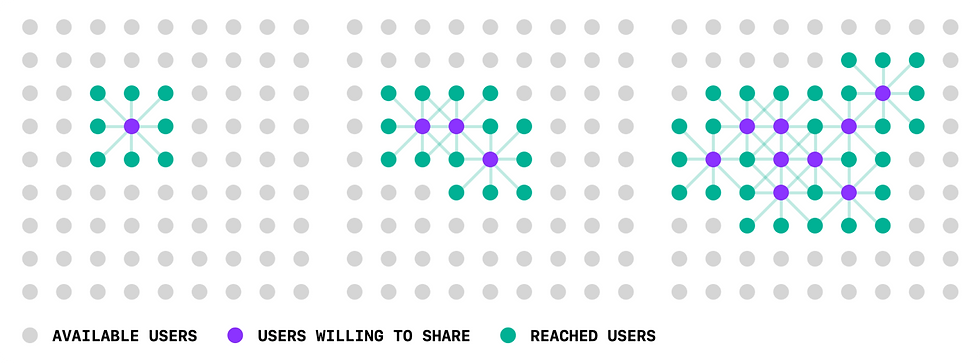
[Fig. 6] The simplified network graph designed by the researcher to illustrate the largest potential reach when different amount of user on a platform are willing to share.
The types of users marketers need to pay great attention to are market mavens, innovators, and opinion leaders. They are usually aware of new products early, enjoy shopping, enjoy talking about products, know many sources to get market information, and most importantly, are willing to watch ads (Petrescu 71). Their high marketplace interest and willingness to express their uniqueness render them “marketing activists" who will be highly involved in market activities, including viral ad diffusion. It is crucial to appropriately target these types of viewers on a platform upon initial ad release to enhance the probability of virality.
In conclusion, the impact of “sharing” and the effectiveness of “spreading” are influenced by platform and technological development (expands the reach of weaker social ties), viewer availability on a social media platform (defines the maximum reach), and viewer types (influences the ease to spread ads on a platform). There are other socio-environmental factors potentially influencing the effectiveness of sharing, including social movements, expectations, the economy, customers’ confidence, social norms, pressing events, trends, and so on. However, there seems not to be existing detailed research on these issues.
STEP II: SEEING / PROCESS II: INFECTING
The key to the success of infecting the user and moving them from simply seeing it to sharing it are the unique qualities that interact with them and, in return, motivate them to decide on sharing. Generally, the process of infecting contains three sub-processes: distinct ad features touch the viewer, build emotional connections with the audience, and under social motives, audiences decide to share.
-
Distinct features & Emotional connection
Since the “sharing” action is primarily voluntary, the ad features ought to be unique and powerful to persuade consumers’ natural reactions — nobody likes to feel “used” as a marketing machine. The key is to promote a positive image of the product to the viewers, even when the ad invokes negative emotions. The ad can illustrate a disturbing thing, but the product should help fight against that universal enemy (Petrescu 80; Dobele et al.). The unique features include plot features, entertainment and humorous appeals, provocative content, and controversy and negative emotions.
Plot: Ads with complete plot development tend to receive better views and have more possibility of propagating. In Quesenberry and Coolsen’s report, ads with a complete story arc receive an average of 3.3 times more views than those without a story. More viewers enjoy watching storyline-based ads as they are easy to follow, catch attention, and may develop sympathy or empathy with the characters (Quesenberry and Coolsen). These attitudes fostered by the story help viewers develop positive emotions and trust in the brand, which may influence their sharing behaviors. Within that story, people like ads with humorous appeals and likable characters (like babies, animals, and celebrities), as Gerard J. Tellis, a professor and director of the Center for Global Innovation at Marshall School of Business, and others pointed out. Usually, ads with storyline development follow the structure of Freytag's five-act drama scale, designing tension and dramatic events that increase oxytocin release and, in return, stimulate trust and attachment (Quesenberry and Coolsen).
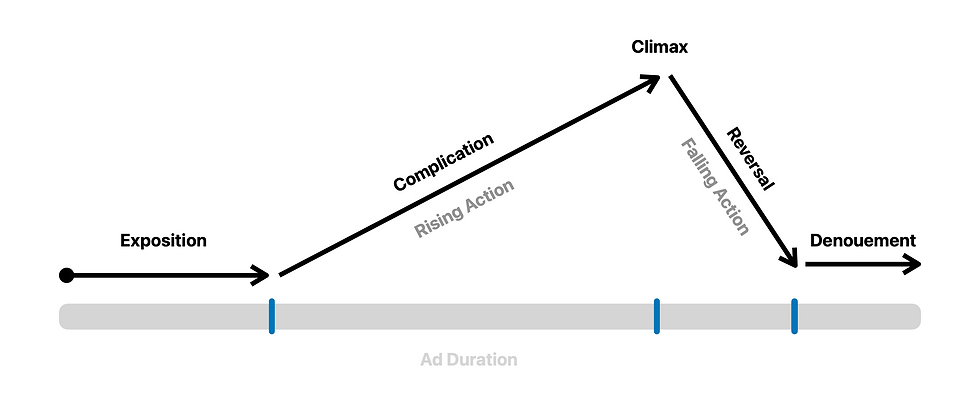
[Fig. 7] Freytag's five-act drama scale, as illustrated in Quesenberry and Coolsen’s article. Modified by the research to match the time duration of the ad Share Your Gift.
For instance, Apple’s 2018 ad Share Your Gift is an excellent example of storyline development that follows Freytag's scale. The ad introduces a shy but creative girl hiding her work in a box (exposition). The tension develops as people try to have a sneak peek at her projects, but she keeps on trying to hide them, worrying that people might dislike them (complication). It reaches the climax when her dog accidentally sets her work free by propping open her bedroom windows. When she rushes downstairs trying to pick them up, she realizes her stunning projects bring people delights (reversal). People’s reactions eventually shaped her confidence, encouraging her to open up and tell her stories (denouement). According to the last available record on Wayback Machine, this ad reached 24 million views on YouTube before getting taken down sometime in September 2019.

[Fig. 8] The storyline development in Share Your Gifts (Apple). The original video got taken down after Apple’s new product released in September 2019.
Entertainment and humorous appeals: Humor gives the ad better chances to be liked and propagated by being engaging and entertaining, creating good feelings and positive emotions. Humor positively impacts attention and recall — viewers are more attentive and remember ad content better, potentially increasing their processing and comprehension of product info and building a positive image of brands and trust of sources (Petrescu 55). Humor also helps reduce irritated feelings when the current content (like a movie) is invaded by an ad (55 - 6). In Will It Blend? - iPad, there are uplifting music and colors: party music as the soundtrack and a warm color palette. The host, Blendtec’s CEO Tom Dickson, presented a highly unexpected but funny way to fit the iPad in the blender jar and quirky things to blend — blenders are commonly associated with fruits, not iPads. The way the iPad turns into ashes is also surprising. Tom’s Facial expressions and the tone he speaks in are very motivating. In the end, the "tough pad" joke refers to the interesting naming controversy of the "iPad" (Stone), as reported by American journalist and New York Times bestselling author Brand Stone. This video is the "Will It Blend?" episode with the highest views — reaching up to 19 million views. Using similar mechanisms, the entire “Will It Blend?” series all have very high numbers of views.

[Fig. 9] The “Will It Blend?” Case - colors, unexpected ways, facial expressions, and double entendres (Blendtec’s Will It Blend).
Provocative content (sex and nudity): Provocative content attracts immediate attention and longer retention. Therefore, the ad will have better persuasion power (viewers are more focused) (Petrescu 57). When appropriate, they generate positive emotions by creating arousal or excitement. Sexy content and humor usually work together, boosting their positive effects. However, it is essential to note that provocative content needs to be highly relevant to the ad, the brand, or the context, and it should not show poor taste (58). Otherwise, many viewers may be annoyed. In the ShakeWeight for Men Infomercial, the marketer repeatedly shows the imagery of a muscly male shaking the phallic-looking ShakeWeight product. The ad develops an enticing ambiance by using phrases like “kick your butt,” and the shaking gesture obviously works as sexual humor. Although being “slightly pornographic,” as described by former CNBC contributing writer Diane Mapes, these images are still highly relevant to their targeted consumers (“for men”) and match the topic of exercising and getting stronger (Mapes). This ad received 205K views in total.

[Fig. 10] Shake Weight For Men Infomercial that contains provocative muscly body scenes (shakeweight).
Controversy and negative emotions (anxiety and anger): the ads evoking controversy and negative emotions usually identify grand causes to viewers and call for action by inducing sincere intentions to fight against the "universal enemies" (61). Note that sadness often does not work (60). They often focus on topics that easily establish an empathetic relationship with the viewers, creating strong reactions and stimulating discussions (Quesenberry and Coolsen). For example, in Dove Evolution (20M views), a model goes through a series of makeup and photoshop processes before appearing on a billboard. The ad ends with a thought-provoking sentence, "No wonder our perception of beauty is distorted" (Dove). According to the lecture by Judy Hopelain, the Continuing Lecturer in the Marketing Group at the UC Berkeley Haas School of Business, the ad was based on the heated discussion on Dove's market research that only 2% of women perceive themselves as beautiful (Hopelain). It sets beauty marketers and the “fake beauty” they promote as the “bad buy” that shapes people’s false perception and deteriorate their confidence. The in-class survey result shows that the ad is unsettling to many of the 108 students. However, that negative emotion eventually translates to the power to disseminate the ad to join Dove's initiative to fight against fake beauty.

[Fig. 11] The emotional response of 108 Berkeley students on the Dove Real Beauty Sketches ad campaign (Hopelain).
Altogether, unique features, including a complete storyline, humor, provocative content, and controversy, help create an internal driving force for viewers to share. Viral ads establish emotional connections with viewers through higher hedonic values (pleasant sensations). Plots, humorous appeals, likable characters, and provocative content create pleasant experiences related to the product. Some other features, like controversy, put the product as the “hope” for a more pleasant experience. Viewers want their social network members to experience empathy through sharing emotional ads with them (Petrescu 54). An ad does not need to address all unique features to go viral. In fact, it can even go against some needed characteristics when one feature is very strong. For instance, Dove's Real Beauty Sketches ad is very informational but utilizes strong controversy and negative emotions to go viral (70M views). Nevertheless, they should avoid significant mistakes that make it disturbing or tedious, like improper use of provocative images.
-
Social motives
Social motives are core reasons ad features and emotional connections translate to sharing. In other words, they are the deepest motivations for humans to share online ads. Seeking an optimal consumer-community image comes first (Hsieh and Lo). The most common three motives are to look like experts, to learn from the shared content, and to express viewers’ uniqueness (Tellis et al.). Reciprocity (for helpful information and emotional support) comes next. Consumers believe that information sharing can be exchanged for other valuable peer rewards like affirmation and feedback (Hsieh and Lo). They share the ad content that gives them positive emotions to make people around them feel as good, hoping that others will do the same (Petrescu 54-6). Community participation comes last but is the most crucial. The core is to create a sense of belonging by sharing opinions on a universal topic and building trust within the network. For instance, people share funny content partly to brag about their ability to find them (Petrescu 56). A lot of shares increase the number of consumers engaging in online discussions about one universal topic (the ad). If other members on the platform consider the shared ad reliable, that creates trust along the networks (Hsieh and Lo). All in all, unique ad features establish emotional connections with its viewers. Viewers will share the ad when they believe it will help them build optimal images, get peer rewards, or establish a sense of belonging in online communities.
CONCLUSION
In conclusion, the virality of an online ad happens when the self-designed “Möbius strip of virality” gets activated for it, circulating it through the “strip” repeatedly. Specifically, the development of social media platforms, the number of viewers on a platform, and the types of viewers available determine the maximum capacity of virality. At the same time, the distinct ad features like plot development, humorous appeals, provocative touches, and controversy establish emotional connections with the viewers, leading to sharing based on viewers’ social motives. Sharing, influenced by the external environment, fosters seeing — the Möbius strip of virality continues.
WORKS CITED
-
Apple. Share Your Gifts. Directed by Ryan Honey, 2018, https://vimeo.com/317706752.
-
Barabasi, Albert-Laszlo. Linked: How Everything Is Connected to Everything Else and What It Means for Business, Science, and Everyday Life. Plume, 2003.
-
Blendtec’s Will It Blend. Will It Blend? - iPad. 2010, https://youtu.be/lAl28d6tbko.
-
Dobele, Angela, et al. “Why Pass on Viral Messages? Because They Connect Emotionally.” Business Horizons, vol. 50, 2007, pp. 291–304.
-
Dove. Dove Evolution. Directed by Tim Piper, 2006, https://www.youtube.com/watch?v=iYhCn0jf46U.
-
Dove US. Dove Real Beauty Sketches | You’re More Beautiful than You Think. 14 Apr. 2013, https://www.youtube.com/watch?v=XpaOjMXyJGk.
-
Fowler, Geoffrey A. “I Gave Instagram Photos of My Baby. Instagram Returned Fear.” The Washinton Post, 12 May 2022, https://www.washingtonpost.com/technology/2022/05/12/instagram-algorithm/.
-
Harvard Museums of Science & Culture. A World of Viruses. https://hmsc.harvard.edu/world-viruses.
-
Hopelain, Judy. Lecture 1 - Market Scoping.
-
Luis Iribarren, José, and Esteban Moro. “Information Diffusion Epidemics in Social Networks.” Physical Review Letters, vol. 103, no. 3, Feb. 2008.
-
Oxford English Dictionary. “liberalism, n.” OED Online, Sept. 2022, https://www.oed.com/view/Entry/107864?redirectedFrom=Liberalism#eid.
-
Oxford English Dictionary. "viral, adj." OED Online, Sept. 2022, www.oed.com/view/Entry/223706.
-
Mapes, Diane. “Stroke of Luck? Shake Weight (Kind of) Works to Tone Arms.” NBC News, 29 Oct. 2010, https://www.nbcnews.com/health/health-news/stroke-luck-shake-weight-kind-works-tone-arms-flna1c9473190.
-
shakeweight. Shake Weight® For Men Infomercial. 20 July 2011, https://www.youtube.com/watch?v=CWtcE52LKgk&t=35s.
-
Petrescu, Maria. Viral Marketing and Social Networks. Business Expert Press, 2014.
-
Phillips, Whitney, and Ryan M. Milner. You Are Here: A Field Guide for Navigating Polarized Speech, Conspiracy Theories, and Our Polluted Media Landscape. The MIT Press, 2021.
-
Sampson, Tony D. “The Accidental Topology of Digital Culture: How the Network Becomes Viral.” Transformations, no. 14, Mar. 2007.
-
Sampson, Tony D. Virality: Contagion Theory in the Age of Networks. University of Minnesota Press, 2012.
-
Statista. Most Popular Video Content Type Worldwide in 2nd Quarter 2022, by Weekly Usage Reach. 14 Nov. 2022, https://www.statista.com/statistics/1254810/top-video-content-type-by-global-reach/.
-
Statista. Number of TikTok Users in the United States from 2019 to 2025. 13 Oct. 2022, https://www.statista.com/statistics/1100836/number-of-us-tiktok-users/.
-
Stone, Brad. “Apple’s iPad: A Controversial Name.” NDTV, 29 Jan. 2010, https://www.ndtv.com/world-news/apples-ipad-a-controversial-name-409961.
-
Tellis, Gerard J., et al. “What Drives Virality (Sharing) of Online Digital Content? The Critical Role of Information, Emotion, and Brand Prominence.” Journal of Marketing, vol. 83, no. 4, Apr. 2019, pp. 1–20.
-
Quesenberry, Keith A., and Michael K. Coolsen. “Drama Goes Viral: Effects of Story Development on Shares and Views of Online Advertising Videos.” Journal of Interactive Marketing, vol. 48, no. 1, May 2019, https://doi.org/10.1016/j.intmar.2019.05.001.
-
Wayback Machine. “Snapshot September 10 2019.” 10 Sept. 2019, http://web.archive.org/web/20190801000000*/https://www.youtube.com/watch?v=3dJCroCMBPM.
ANNOTATED BIBLIOGRAPHY
[1] Parikka, Jussi. "Viral Aesthetics." The Johns Hopkins Guide to Digital
Media, Marie-Laure Ryan, et al., Johns Hopkins University Press, 1st edition, 2014. Credo Reference, https://libproxy.berkeley.edu/login?qurl=https%3A%2F%2Fsearch.credoreference.com%2Fcontent%2Fentry% 2Fjhupjohns%2Fviral_aesthetics%2F0%3FinstitutionId%3D505.
In this chapter of the book, The Johns Hopkins Guide to Digital Media, called “Viral Aesthetics,” Jussi Parikka, new media theorist and Professor in Digital Aesthetics and Culture at Aarhus University, briefly elaborated on the relationship between digital aesthetics, virality, and the milieu by introducing several related cases. The author claims that virality comes from aesthetics, representation, visualization, and presentation. This work proposes a mathematical perspective to explain network effects fostering sharing of viral content. It is an excellent reference to the macro social environment but is too theoretical and lacks an in-depth analysis of the characteristics of viral ads.
Compared to other works in this bibliography that focused on in-depth but narrower insights into viral ads, this work presents a general birds-eye view of all viral content on the web. It is more of a brief introduction, is less detailed, and may not make it into one of the works cited articles in the final project. However, it is handy to point a direction for my research — how the viral phenomena can be related to the social environment. It helps me notice the “environmental factors” of virality and the “internal factors.” It also points to other valuable resources in its reference section.
[2] Barabasi, Albert-Laszlo. Linked: How Everything Is Connected to Everything Else and What It Means for Business, Science, and Everyday Life. Plume, 2003.
According to the UC Library, Albert-Laszlo Barabasi, a network scientist who is also the Robert Gray Dodge Professor of Network Science at Northeastern University, is “nation’s foremost expert in the new science of networks” (UC Library). His book Linked compares historical social network models and offers new variations of them. It states that human innovations in an interconnected world also spread in a contagious network, just like viruses. This book was written from a network sciences perspective and focused more on links between networks and the flows of information on them. Therefore, I might need to thoroughly read the book, pick up insightful information and reconstruct, repurpose, and cross-reference them to get compelling insights on ad virality.
This book will provide fresh ideas on integrating historical evidence into my research. One of my classmates in the UGBA class inspired me to look up “network effects,” and I think this book will provide some insight into this concept. It can provide a deep understanding of “social environment” — one of the environmental factors of virality I summarized — and construct arguments based on it. Depending on the information I get from reading this book, I might even reconstruct some of the core arguments as this book provides a vital look into how shared information gets passed on, and “sharing” is a vital element of my “Möbius strip of virality.”
[3] Berger, Jonah, and Katherine L. Milkman. “What Makes Online Content Viral?” Journal of Marketing Research, vol. 49, no. 2, Apr. 2012, pp. 192–205. https://www.jstor.org/stable/23142844.
Author Jonah Berger and Katherine L. Milkman are Professors at the Wharton School of the University of Pennsylvania. In their peer-reviewed article, which has been cited over 3,400 times on Google Scholar, they focused on published work in the New York Times magazine to analyze the effect of emotions on the virality of contents. According to their research results, contents that induce highly positive or negative emotions spread more virally as they stimulate activation for the transmission of information. The credentials of the professors suggest that this article was written from a business-focused perspective, and factors influencing the sharing of ads may vary from those that induce sharing of non-commercial content.
This article focuses on a psychological approach, which will be a nice addition to [4] on this list which is more data- and category-focused. It helps me notice “emotion” as a crucial factor under the “psychological changes,” an internal factor of virality I brainstormed. One possible limitation of this work is that since it was published ten years ago, in 2012, some descriptions might not perfectly match today’s more-developed internet and social environment.
[4]. Tellis, Gerard J., et al. “What Drives Virality (Sharing) of Online Digital Content? The Critical Role of Information, Emotion, and Brand Prominence.” Journal of Marketing, vol. 83, no. 4, Apr. 2019, pp. 1–20. https://doi.org/ 10.1177/0022242919841034.
This peer-reviewed article cited by 237 people on Google Scholar is the result of the collaboration among Author Gerard J. Tellis, a professor and director of the Center for Global Innovation at Marshall School of Business, Deborah J. MacInnis, a Charles L. and Ramona I. Hilliard Professor of business administration and marketing at Marshall School of Business, Seshadri Tirunillai, an assistant professor at C.T. Bauer College of Business, and Yanwei Zhang, a Staff Data Scientist at Uber Technologies Inc. The authors’ credentials indicate that this is a more business-focused article and focused majorly on online ads. Their article tested their six hypotheses on theoretical virality factors: information density, purchase risks, emotions, plots, brand placement, and length. According to their research, positive emotions, drama elements, and rich information at high purchase risks seem to be the most significant, if not the only, factors that help boost virality as they create the self, social, and altruistic motivations. This peer-reviewed article provides a very in-depth look into the factors it mentioned. However, their hypothesis may not capture all aspects of human choice and emotions — they generalized and categorized them too much. Also, the limited sample size with their “coders” may present some biases.
This journal article offered ideas on six sub-categories of “distinct features of the ads.” Part of it presents a major counter-argument to [3] on this list, saying that high- and low-arousal emotions have no visible difference in motivating sharing. The already-rich information related to online ads makes me consider focusing on viral online video ads only rather than the broader “viral videos.” It also helps me extend my design of the “Möbius strip of virality” by including factors causing virality between “Seeing” and “Sharing” and inspires me to construct my arguments based on this “strip.”
[5] Quesenberry, Keith A., and Michael K. Coolsen. “Drama Goes Viral: Effects of Story Development on Shares and Views of Online Advertising Videos.” Journal of Interactive Marketing, vol. 48, no. 1, May 2019, https:// doi.org/10.1016/j.intmar.2019.05.001.
Author Keith A. Quesenberry is a marketing professor and researcher at Messiah College, while Michael K. Coolsen is a professor of marketing at Shippensburg University. Just like the previous two sources, the two professors’ positions and focused research area indicate that this article is focused more on a business perspective. It has been cited only 35 times, according to Google Scholar. However, these relatively fewer citations could be due to the smaller institutions the professors come from and may not be an indicator of lower accuracy. Their peer-reviewed article presented the research result after analyzing 155 viral marketing videos: those videos with drama or full storyline development usually gain more reviews and shares.
This article sheds light on a critical aspect of the internal factor, “unique features of an ad.” It presents the extension of one of the arguments (plots and drama) of the article [4], and unlike the comprehensive article [4], this article can provide me with a more in-depth view of this aspect. It specifically mentioned the process of “reach,” which contained “finding” and “sharing.” This description inspired me to construct the “Möbius strip of virality,” the overall focus of my research project. It also helps me argue that the strip is the “secret” behind virality.